- Best for
- Renters who want a spa-like bathroom without drilling
- Cost
- $485 total, under a $500 ceiling
- Difficulty
- Easy—mostly textiles, art, and styling
- Time
- About a long weekend (2–4 hours plus drying/pressing if DIY)
Why warm greenery is the botanical bathroom of 2026
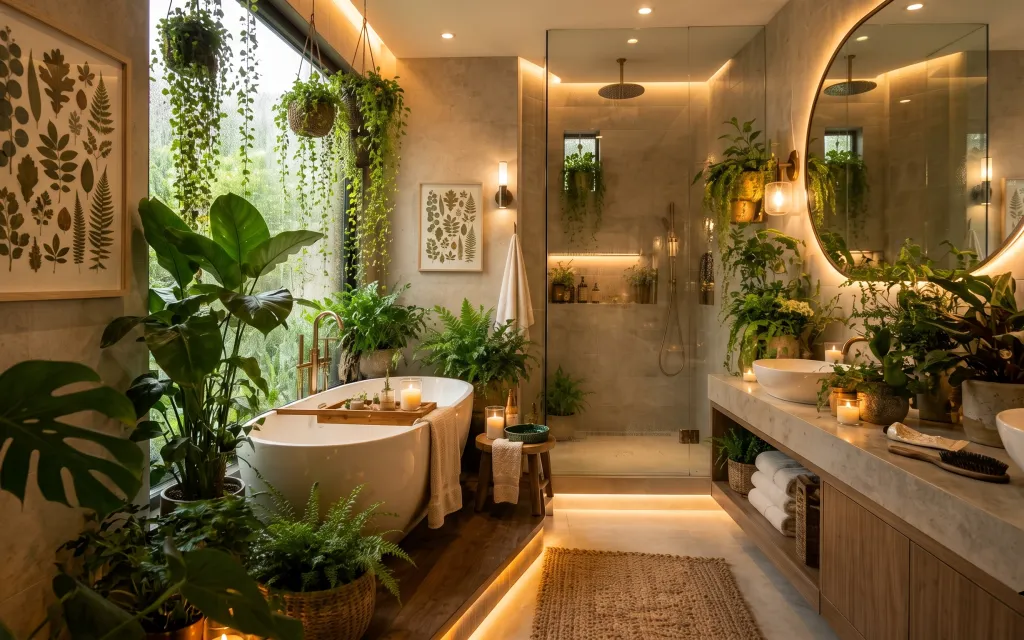
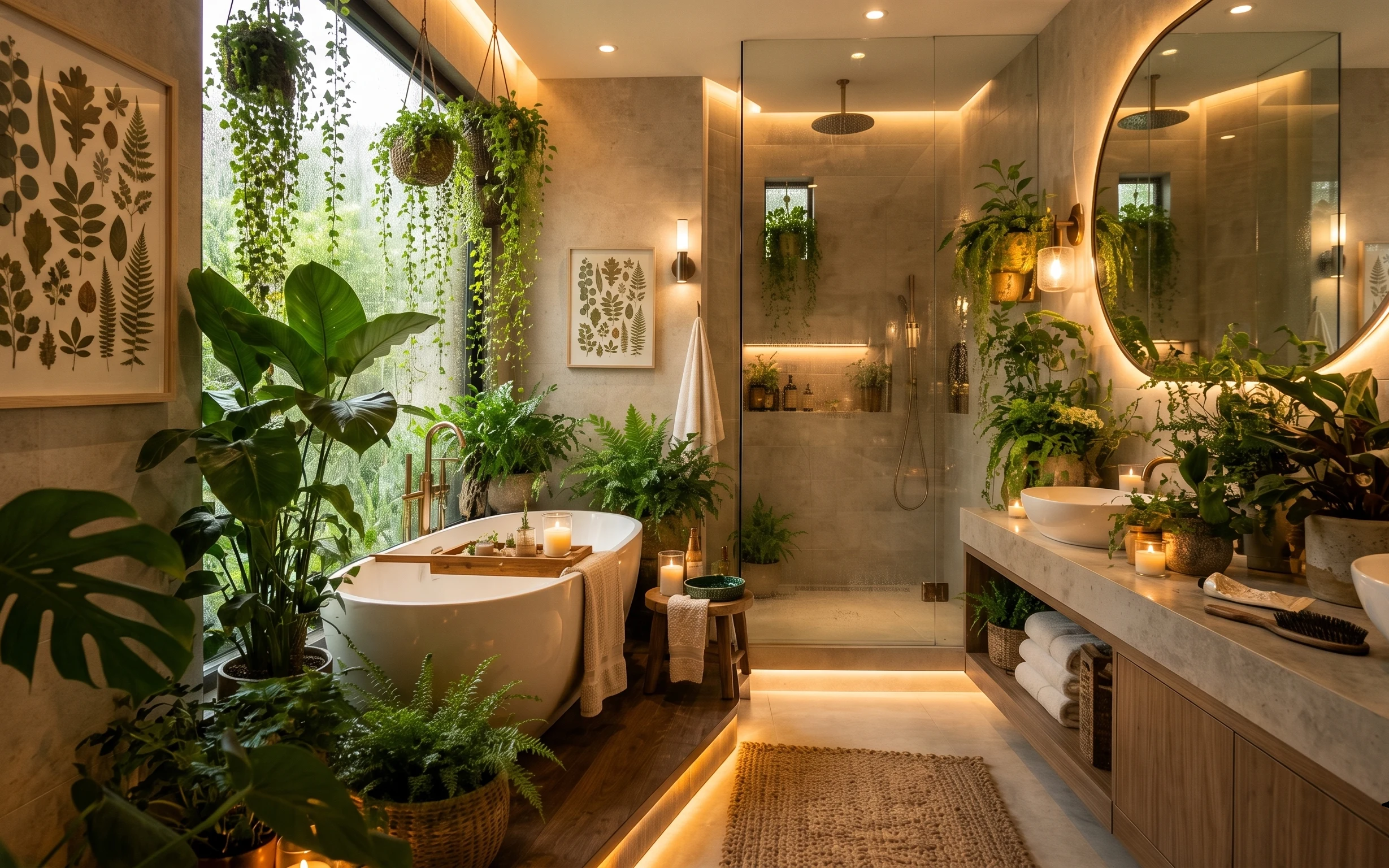
Start with the textures you can actually see at a glance: that woven rug underfoot, the crisp white towel, and the way the round mirror catches candlelight. The framed botanical print brings a graphic “garden” pattern to the wall, while hanging planters and leafy potted plants add real depth at multiple heights. A classic design rule from magazines like Elle Decor is to mix one strong focal (mirror + print) with lots of smaller repeats (leaf shapes and candle glow). This is budget-achievable for renters because the main moves are wall-hanging art, plug-and-play lighting through candles, and flexible styling.
I used to overthink bathrooms—like I needed matching wall-to-counter everything to make it look intentional. This photo is the opposite: the cohesion comes from a single palette (warm beige + cream + green) and repeating plant silhouettes, not from expensive fixtures. The biggest “aha” for me was giving the mirror area a styling zone—tray, candle, and a couple of small plants—so it reads styled even when you’re not doing a full clean before a guest arrives.
Layer 1 — woven textured rug ($150) underfoot warmth that hides reality
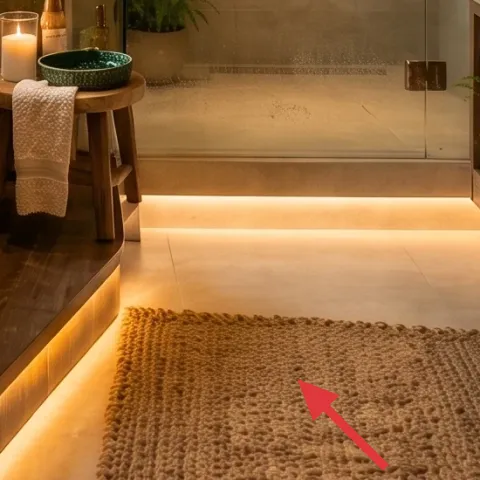
The woven textured rug sits in front of the vanity area and immediately softens hard bathroom surfaces. In a room like this, it’s more helpful than a slick mat because the texture disguises everyday water splashes and adds visual rhythm against the stone and smooth cabinetry. The color stays warm beige, so it doesn’t compete with the green plants or the cream towel. A plain neutral rug can look a little flat here, so the choice is a slightly rough, woven look that catches the warm light at the edges.
Go for texture, not just color
Woven fibers reflect warm light in a way that looks expensive, even in photos taken on a phone.
Layer 2 — framed botanical wall print ($80) patterned greenery without commitment
That framed botanical wall print anchors the whole palette: leaf silhouettes repeat the plant shapes you see in the window and on the ledge. This is the “stay-up” piece—when everything else is moved around for cleaning, the print keeps the room feeling designed. The trade-off is that you’ll want it to be crisp and centered, because blurry art reads sloppy next to the clean mirror line. For renters, it’s also an easy swap: Command-hook hanging means no wall damage and everything can come down at move-out.
Make it instead of buying it
This pressed flower frame recreates the botanical line-art vibe by layering real plant textures behind glass in a renter-safe frame.
Materials
- Dried botanicals (ferns/leaf pieces) — handful — foraged/collected — $8
- Paper or lightweight cardstock backing — A4/A3 sheet — craft store — $10
- Glass-front frame (small) — 1 — thrift/discount store — $12
- Clear glue or gel medium (optional) — small bottle — craft store — $18
- Command hook for hanging — 1 pair — hardware/office store — $7
Steps
- Choose and press the botanicals first so leaves lie flat.
- Lightly sketch a simple “sprig” layout on the cardstock backing.
- Arrange botanicals over the sketch without gluing yet.
- Trim any pieces so they don’t overlap the frame edges.
- Seal the arrangement with a thin layer of glue/gel medium, then let it set.
- Insert the backing into the frame and check spacing behind the glass.
- Attach the frame to the wall with a Command hook at the center point.
- Stand back and nudge the botanical placement until the stems look balanced.
- Let the final set finish before handling the frame often.
Total DIY cost: $55 — saves about $25 over buying.
Layer 3 — round wall mirror ($120) for that glowing, garden-in-the-glass effect
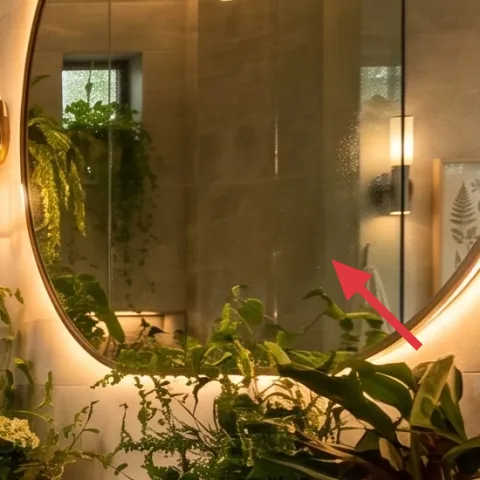
A round mirror gives the bathroom a softer shape than the usual rectangle and makes the greenery feel intentional instead of chaotic. In the photo, the mirror also multiplies warmth by reflecting candlelight and plant leaves, which is why the whole scene reads “spa” rather than “random plants.” The trade-off with a statement mirror is that it needs clean placement—if it’s off-center, the symmetry won’t do its job. A smaller mirror can work, but it won’t catch as much of the candle glow or reflection detail.
Use the reflection, not just the mirror
Cluster small plants and a candle where they’ll be visible in the mirror’s inner circle.
Layer 4 — candle in jar on vanity ledge ($30) warm light without rewiring
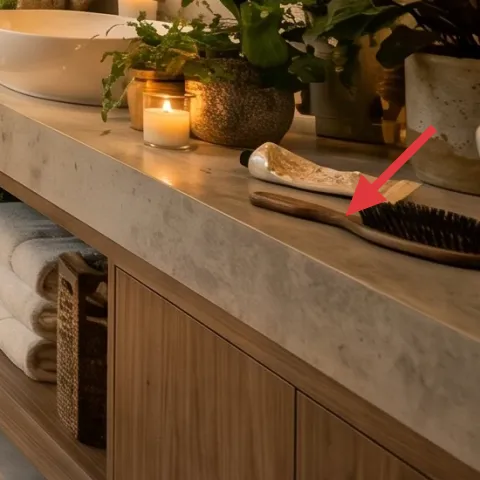
That jar candle on the vanity ledge reads like soft lighting rather than decor, and it’s one of the easiest renter-friendly changes in the room. The warm flame pairs with the mirror’s glow so the bathroom feels calmer and more “intentional” in the evening. Candle placement matters: too close to towels or stacked objects and it looks accidental. Here, the candle sits on the ledge among plants so it functions like a focal point you can reset quickly after use.
Keep it away from towels and greenery
Set candles on stable, dry surfaces with enough clearance so leaves and fabric can’t drift too close.
Layer 5 — decorative tray on vanity ledge ($35) the organizer that makes styling look planned
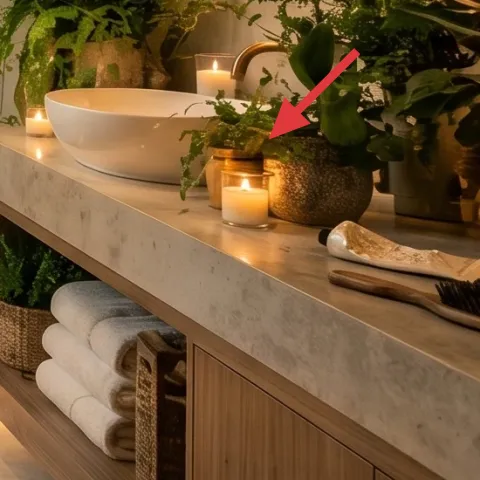
A decorative tray turns “stuff on a ledge” into a composed vignette. In this bathroom, the tray groups small items—like candles and tiny plant pots—so they read as one look, not separate clutter. The trade-off is height: you’re adding another layer on the ledge, so keep objects short and leave space for everyday bathroom use. This is also a smart move for renters because trays are easy to pack, wipe clean, and move to a new countertop without changing anything else.
Choose tray dimensions that fit one “cluster”
If the tray is too big, it looks empty; too small, and you lose the organized effect.
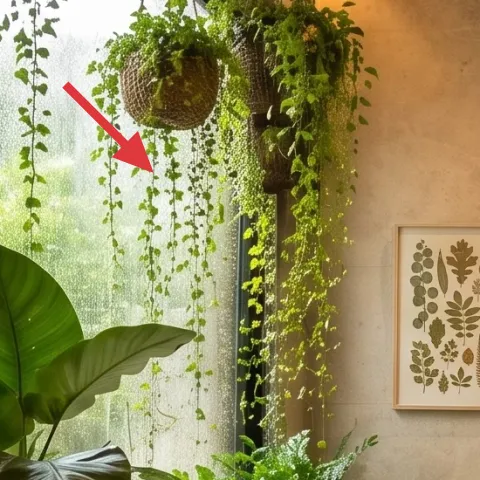
Layer 6 — hanging round plant planter ($40) instant vertical lushness
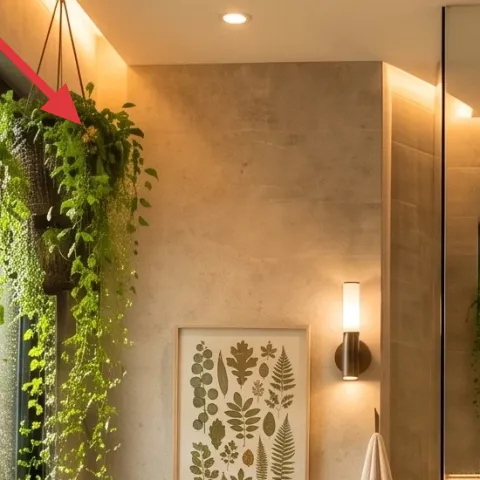
The hanging round plant planter creates vertical movement and makes the window-side greenery feel layered instead of flat. It’s the exact kind of visual trick that makes a small bathroom feel bigger—your eye travels upward, then back to the mirror. The trade-off is maintenance: hanging plants need a consistent watering rhythm and good drainage. In a renter setup, the best part is that planters and hooks can be swapped out without altering walls. Choose a style that matches the room’s warm tones so the metal details don’t pull attention from the leaves.
Match the planter tone to your hardware
Warm metals and earthy finishes make the greens look richer without fighting the lighting.
Layer 7 — white bath towel hanging on hook ($40) crisp contrast for a busy botanical palette
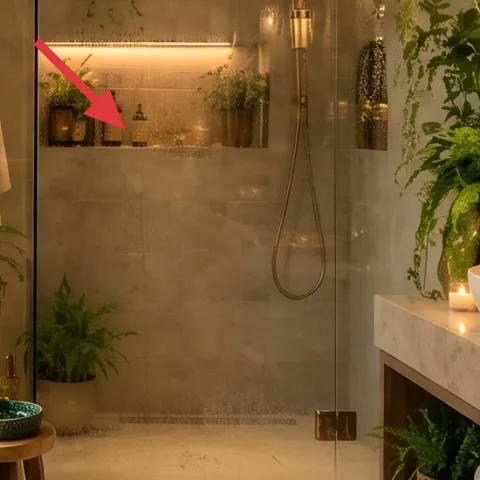
The hanging white towel adds a clean “break” between the green foliage and the warm mirror glow. It’s not just practical—it also balances the organic shapes with a solid, light color that reads fresh in photos. The trade-off is that towels need frequent resets; a wrinkled or oddly folded towel makes the room look less intentional. Here, the towel is kept simple and centered, which makes it look styled rather than shoved up on a hook. Swap in a second towel roll or quick fold to keep the look consistent.
Fold for symmetry, not perfection
A clean, repeatable fold makes the towel look intentional even on busy mornings.
The cost, layer by layer
| Layer | Item | Cost |
|---|---|---|
| 1 | woven textured rug | $150 |
| 2 | framed botanical wall print (DIY) | $80 |
| 3 | round wall mirror | $120 |
| 4 | candle in jar | $30 |
| 5 | decorative tray | $35 |
| 6 | hanging round plant planter | $40 |
| 7 | white bath towel | $40 |
| Total | $485 | |
If you want to spend less, swap the rug for a simpler flat-weave runner and choose a smaller mirror. Keep the tray + candle + towel, then add one statement plant (either hanging or large potted) instead of both.
What worked, what didn't (across the whole room)
The overall look succeeds because it uses repetition—leaf shapes, warm light, and a consistent beige-cream-green palette—rather than relying on expensive fixtures. The one thing that can easily go wrong in a botanical bathroom is overstuffing surfaces, which makes it feel cluttered instead of calm.
What worked
- The woven textured rug grounds the scene and softens the hard, light-stone surfaces.
- The framed botanical wall print repeats leaf silhouettes so the plants feel “curated.”
- The round wall mirror adds warmth by reflecting candlelight and plant shapes.
- The candle-in-jar glow makes the bathroom feel spa-like without any wiring changes.
- The decorative tray keeps small items from looking scattered across the ledge.
- The hanging round plant planter adds vertical depth, which reads like more space.
What didn't
- If the botanical print is off-center, the mirror reflection starts to look accidental.
- Hanging planters require consistent care; neglect shows up quickly in drooping leaves.
- Candles can look messy when placed too close together or without a tray grouping.
- Too many small pots on the ledge makes the styling feel busy instead of botanical.
- Using an ultra-smooth rug can read cold against warm beige walls and tan wood flooring.
What we'd skip if we did it again
Skip swapping for a “matching set” of bathroom accessories. In rooms like this, the matchy-matchy look fights the botanical mix; better to stick to one palette and let textures do the work.
Skip going big on wall decor at random. The framed botanical print is the anchor—adding extra competing prints or multiple patterns usually makes the mirror area feel crowded.
Skip overloading the vanity ledge. Keep a tray, one candle moment, and just a couple of small plants; anything beyond that stops looking like styling and starts looking like storage.
Frequently asked
How long does this kind of bathroom refresh take?
Most of the look is quick swap work: rug + towel + candle + tray placement, plus hanging one framed print and adding planter styling. Expect about 2–4 hours total if everything you buy arrives ready. If you DIY the pressed flower frame, add pressing/settling time, then plan for a careful center-and-level hanging moment so it looks intentional in the mirror.
Is this renter-friendly if my bathroom has limited wall space?
Yes. The heaviest visual lift comes from items you can hang or place without altering anything permanent: framed art, a mirror, and towel styling. If your wall space is tight, keep the framed botanical print and the round mirror as the only wall elements, then add greenery through table/ledge plants and one hanging planter for height.
What if my bathroom is smaller than the photo?
Make fewer moves, not smaller impact. Keep the rug, one candle moment on a tray, and the botanical print. For greenery, choose either the hanging round planter or the large potted plant—but not both—so the room stays breathable. A compact round mirror still gives you that reflective “glow” effect.
What if my bathroom is bigger and feels empty?
Add depth before you add more clutter: use a larger hanging planter with more trailing greenery, and add a second small plant grouping on the opposite side of the mirror reflection. Keep surfaces organized with the tray so the extra greenery reads layered rather than random.
Where should I shop for these kinds of pieces?
For the fastest renter wins, look at discount home goods for the rug and tray, and thrift stores or resale apps for the frame and mirror. Plant planters and candles are widely available at garden centers and big-box stores. For Command-hook hanging, office-supply brands are usually the easiest to source.
What’s the biggest mistake people make with botanical bathroom decor?
Over-stuffing the ledge and under-thinking the palette. The room looks calm when leaf silhouettes repeat and the neutrals stay consistent (warm beige, cream white, green). If every item is a different color or shape, the mirror reflection amplifies the visual noise and the bathroom stops feeling like a spa.
More in Bathroom
7 renter-friendly botanical bathroom swaps for a $500 refresh
A botanical bathroom refresh for renters with no drilling—plus move-out-friendly styling. For about $500, this look adds a warm rug, a roun…
7 weekend swaps for a $600 freestanding bathtub corner refresh
Turn a freestanding bathtub corner into a spa-ready bathroom for $600. This weekend refresh leans on warm brass accents: a round gold mirro…
How to get a spa bathroom look for under $700
A plant-forward, marble-and-brass spa bathroom setup that reads expensive—built from 7 swaps you can shop this weekend. With a $700 target,…