- Best for
- Renters who want warm earthy neutrals without wall changes
- Cost
- About $600 total
- Difficulty
- Mostly buy-and-style; DIY framed art takes an hour
- Time
- 2–4 hours from shopping to styling
Why warm earthy-neutrals is the sofa-and-coffee-table living room of 2026
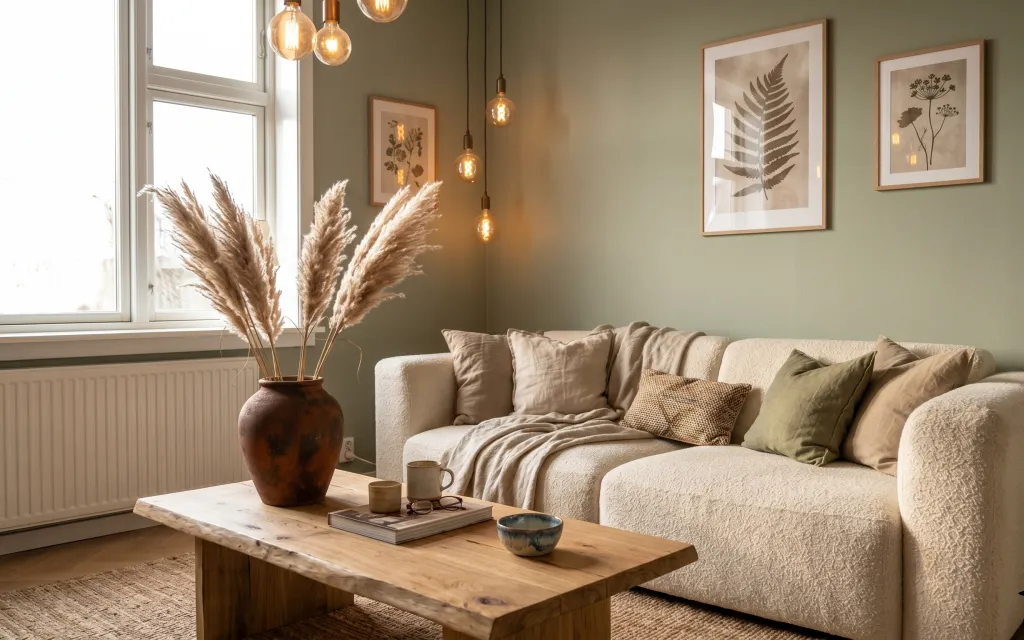
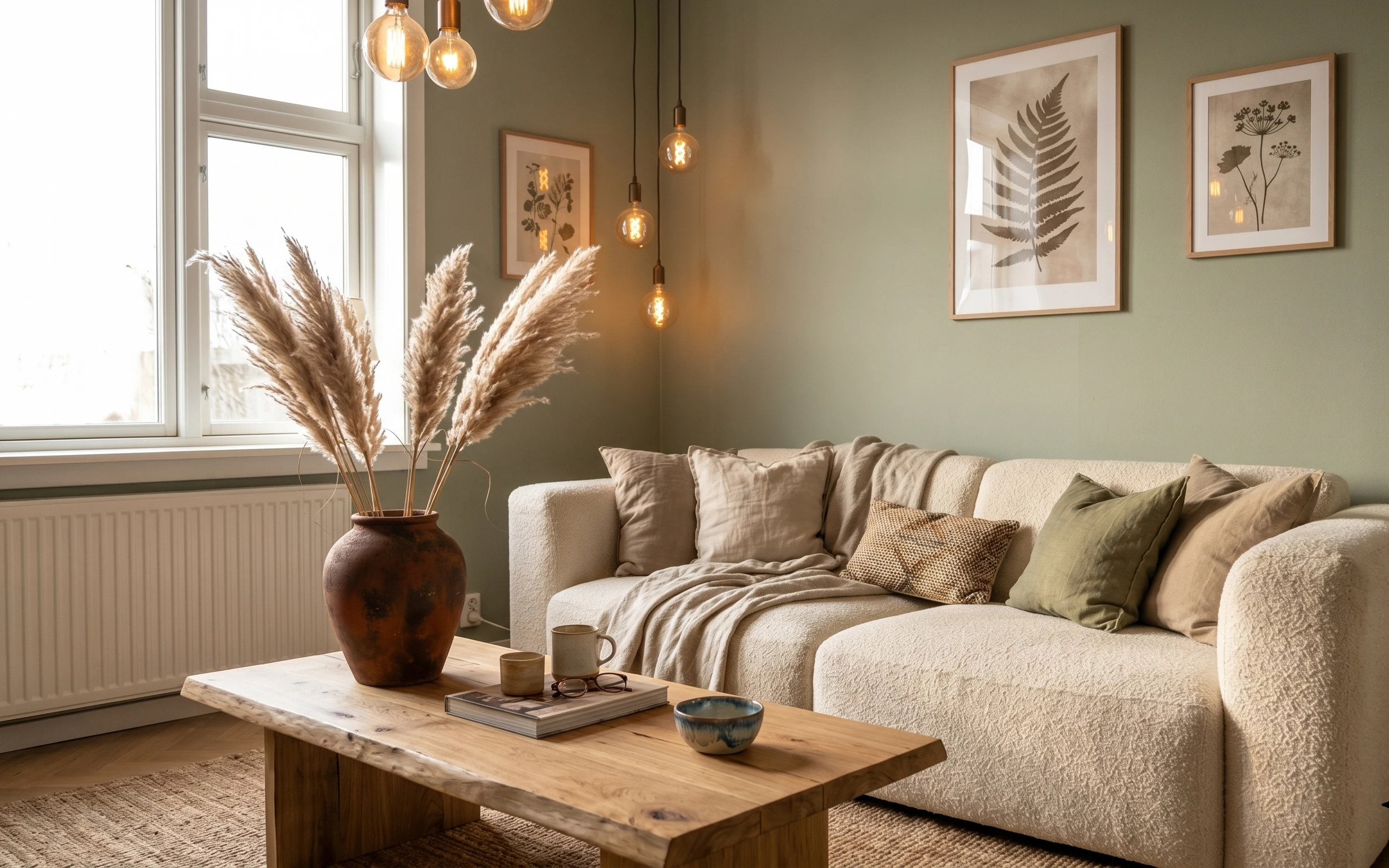
The vibe here works because it’s built out of real materials you can feel: a thick beige knit throw, a light neutral rug underfoot, and soft ceramic objects grouped on a honey-toned coffee table. The framed botanical prints keep everything from going plain, while the hanging warm-bulb lights add movement and glow above the seating. For renters, the best part is how little you need to commit to—no wall changes, just layered styling and swap-in lighting.
I used to overdo “theme” decor and end up with too many similar items on the same plane. In this kind of room, I’ve learned to spread the interest across heights: floor (rug), surface (tray + ceramics + books), wall (botanical frames), and air (hanging bulbs). That little shift is what makes the setup feel intentional instead of crowded.
Layer 1 — area rug 5×7, light neutral ($200) Anchor for soft, no-friction seating
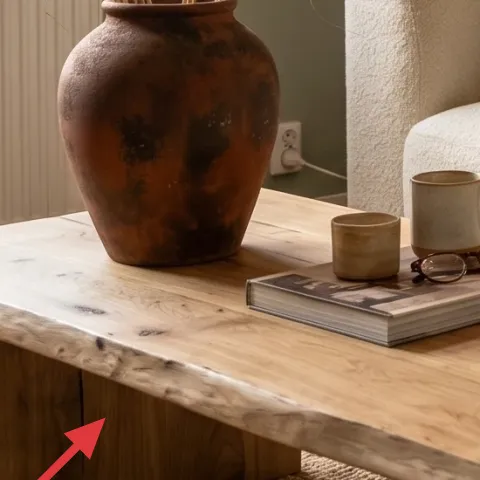
A 5×7 light neutral rug is what makes the whole room feel finished, especially with a sofa and coffee table sitting close to the floor. In the photo, the rug’s woven texture reads as “grounding” without competing with the botanical prints or the terra-cotta vase. The obvious alternative is a smaller rug that only sits under the coffee table, but that leaves the sofa area floating. This size keeps the ottoman-free layout visually supported and also helps hide everyday mess from the high-traffic path by the windows.
Build a buffer
Give at least a few inches of rug showing around the sofa and table so shadows don’t slice the room into sections.
Layer 2 — wood coffee table, honey tone ($180) Warm surface for books, ceramics, and contrast
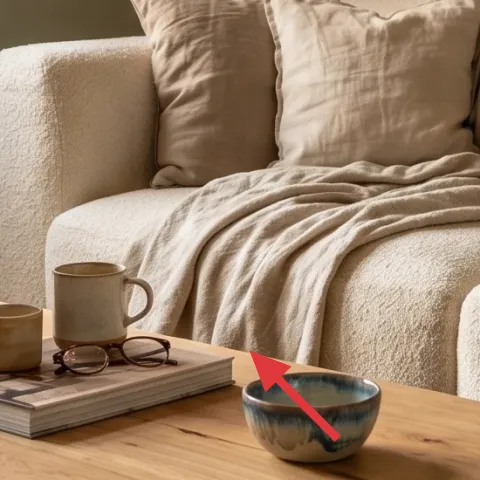
The honey-toned wood coffee table is doing quiet work: it bridges the beige textiles with the warm amber lighting overhead. On the tabletop, you can see how it holds a stack of books and a few ceramic pieces without looking cluttered—wood is forgiving like that. The alternative would be a glass or metal table, but that often makes warm bulbs look harsher and can feel “cold” against knit textures. This wood tone also matches the terra-cotta vase vibe, so your decor doesn’t feel like random objects spread around.
Let the grain show
Keep the tabletop styling to a tray + 2–3 ceramics so the wood grain stays part of the look.
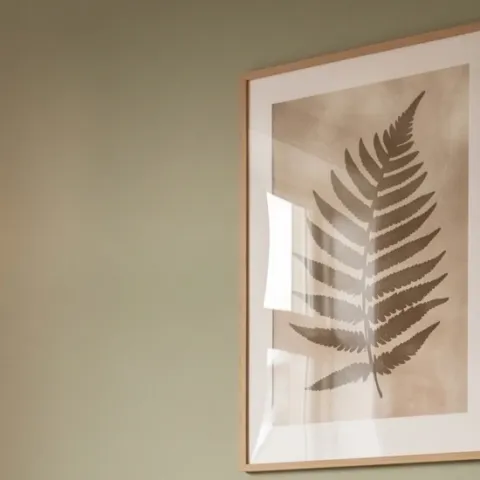
Layer 3 — framed botanical print, beige fern ($80) Your no-drill way to keep the wall from feeling blank
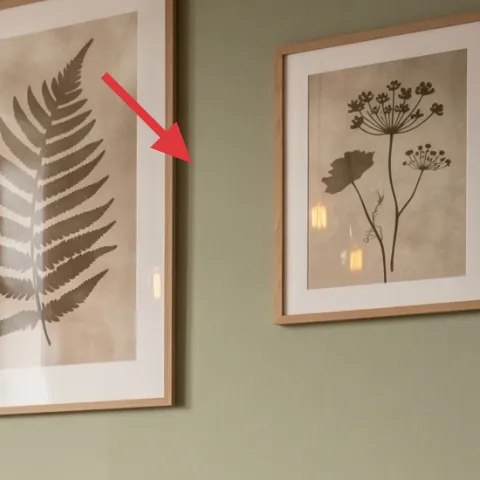
Those framed botanical prints are the room’s visual “pause button.” They echo the pampas-like plant shape with airy leaf forms, but still read structured because of the clean frame lines. If you buy ready-made art, look for a beige palette so it ties into the knit throw and rug, not the green wall. The DIY version here keeps the same role—botanical calm in a renter-friendly frame—so you’re not paying for multiple matching pieces. The trade-off is you’ll need to accept small imperfections, which actually make it feel more lived-in.
Make it instead of buying it
This replaces the framed botanical print with an abstract fern-like composition on cardstock that still reads soft at a distance.
Materials
- Small poster/frame (to match your existing frame size) — 1 — craft store — $20
- Cardstock (thick, smooth) — 1 pack — office supply — $12
- Set of acrylic paint (beige/umber/cream) — 1 set — craft store — $6
- Small flat brush + round detail brush — 1 set — craft store — $8
- Painter’s tape — 1 roll — hardware store — $10
Steps
- Choose your frame opening size and cut cardstock to fit snugly.
- Tape off a light “leaf lane” where the main fern shapes will sit.
- Paint 2–3 main feather strokes in a cream tone.
- Layer smaller feather marks in a beige or warm umber shade.
- Add a few negative-space gaps so the lines don’t turn into a blob.
- Let the paint fully dry before removing tape.
Total DIY cost: $56 — saves about $24 over buying.
Layer 4 — hanging bulb string lights (set), warm amber bulbs ($15) Ceiling glow that keeps the room soft after dark
Those hanging bulbs create warmth where the eye otherwise drops straight to the sofa. They’re especially effective in a room with a lot of neutrals, because the amber glass adds color without adding more “stuff.” The easiest renter approach is a plug-in set you can hang with a removable hook, leaving no marks behind. I’d normally worry about cords looking messy, but in this layout the bulbs are spaced vertically, so it reads intentional instead of accidental. The trade-off is bulb warmth can be strong—use the lowest-brightness option or a warm white bulb so the botanicals stay gentle.
Watch the heat + cord path
Keep cords away from any radiator and make sure the plug isn’t under a rug edge.
Layer 5 — decorative tray on coffee table, neutral ceramic ($25) A styling “container” for instant order
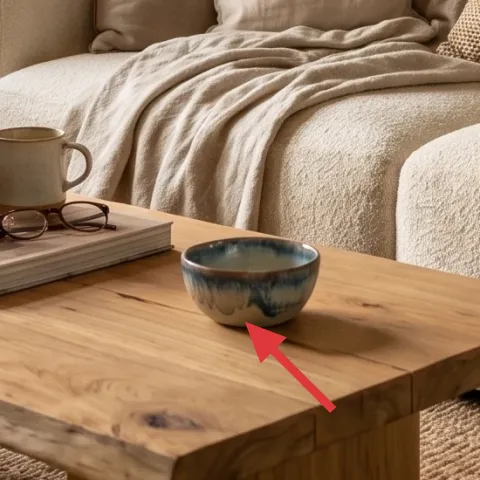
A decorative tray is what turns a coffee table full of small objects into a curated vignette. In the photo, the tray holds a small ceramic mug and pairs nicely with the nearby bowl, while the books add height and structure. Without a tray, the table can quickly look like things have “drifted” into place—especially when you add mugs, coasters, and whatever you’re reading. I like ceramic trays on a wood table because they repeat texture, not just color. The trade-off is that you’ll need to keep the pieces inside the tray footprint so nothing spills beyond it.
Use the 2-height rule
Anchor the tray with one low piece (bowl) and one mid piece (mug) so the top of the vignette stays tidy.
Layer 6 — terra-cotta vase with pampas grass stems ($35) The plant moment that connects wall art to the floor
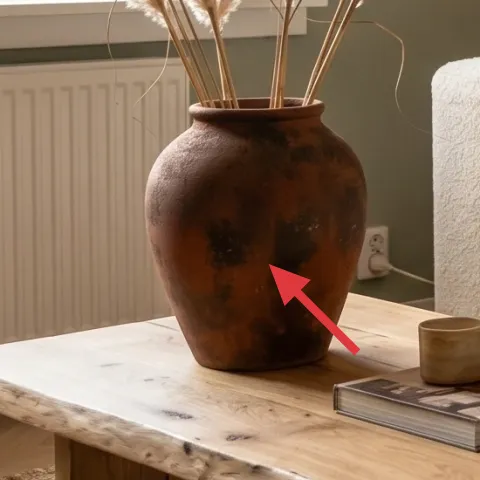
The terra-cotta vase and pampas stems bring in the room’s “soft motion.” The vase gives you that warm clay color that echoes the amber bulbs, and the feathery texture repeats the botanical theme in a more natural, dimensional way. If the vase is smaller or the stems are too short, the arrangement starts to look like decoration instead of focal styling. The better choice here is a medium vase with stems tall enough to rise above the table line, so the plant becomes part of the room’s height scale. The trade-off is occasional fluffing—pampas tends to shed a bit, so plan a quick clean-up.
Fluff before guests arrive
A 20-second shake and light finger-styling makes the stems look fuller without replacing anything.
Layer 7 — throw blanket (beige knit texture) on sofa ($60) Texture you can see from across the room
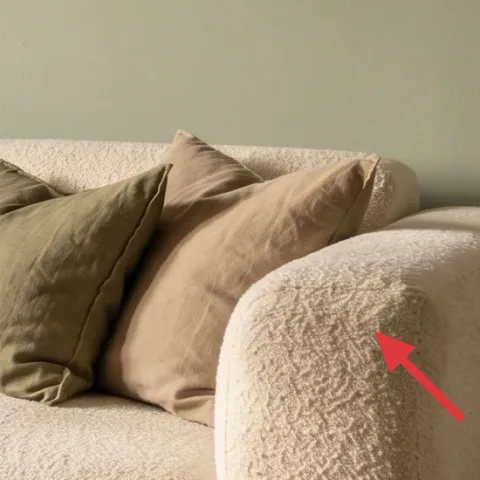
The beige knit throw is the texture link between the rug, the sofa cushions, and the framed botanicals. It reads cozy without turning the room into a blanket pile because it’s draped in a broad fold rather than scattered randomly. I’ve made the mistake of choosing a throw that’s too thin—then the color shows, but the weave doesn’t, and the room feels flat. A knit with visible texture keeps the look dimensional, especially under warm hanging bulbs. The trade-off is you’ll want to keep it off the edges where it picks up lint easily, so it stays looking intentional day to day.
Drape, don’t stack
Let the throw fall in one main sweep so it looks like part of the sofa, not an add-on.
The cost, layer by layer
| Layer | Item | Cost |
|---|---|---|
| 1 | Area rug 5×7, light neutral | $200 |
| 2 | Wood coffee table, honey tone | $180 |
| 3 | Framed botanical print (DIY abstract on cardstock, in a frame) | $80 |
| 4 | Hanging bulb string lights (set) | $15 |
| 5 | Decorative tray on coffee table, neutral ceramic | $25 |
| 6 | Terra-cotta vase with pampas grass stems | $35 |
| 7 | Throw blanket (beige knit texture) | $60 |
| Total | $595 | |
If you want to spend less, swap the coffee table for a simpler wood-look table and choose a rug in a similar light neutral family (same size). The wall can also stay minimal with one framed print instead of two.
What worked, what didn't (across the whole room)
This setup nails warmth by repeating beige textures and amber lighting, then preventing blandness with botanical art at eye level. Most of the “cozy” feeling comes from how objects share height (rug → table vignettes → wall frames → hanging bulbs). The only friction points are practical: lighting placement and how quickly small tabletop items multiply.
What worked
- The light neutral 5×7 rug anchors the sofa zone and reduces visual clutter from the floor plan.
- The honey-toned wood coffee table adds warmth that matches the amber bulbs above.
- Framed botanical art keeps the green wall from feeling flat while staying renter-safe and removable.
- The hanging bulbs create vertical interest and make the room feel softer after dark.
- A tray turns scattered ceramics into a deliberate vignette.
- Terra-cotta plus pampas repeats the botanical theme with texture, not just color.
What didn't
- Too-bright bulbs would wash out the beige throw and make the wall art less defined.
- Without a tray, mugs and small dishes tend to drift into an untidy pile.
- If the pampas stems are too short, the plant stops adding height and becomes decorative instead.
- A thin throw reads flat under warm lighting and doesn’t create the knit texture contrast.
What we'd skip if we did it again
Skip buying extra wall decor that matches the botanical prints too closely. In this room, two framed pieces are enough—more prints start competing with the plant texture and the hanging bulbs’ vertical rhythm.
Skip a low-cost light fixture that isn’t actually warm-toned. With neutrals, a cooler bulb makes beige look gray and can flatten the knit throw and ceramics.
Skip a coffee table styling routine that spreads objects across the entire surface. The tray-and-books layout works because it’s contained; outside that container, small items quickly look accidental.
Frequently asked
How long does this living-room refresh take?
If the main items are already purchased, it usually takes 2–4 hours: rug placement, table styling, hanging the framed print(s) safely with removable methods, and arranging the plant and lighting. The DIY framed artwork adds about 45–90 minutes depending on drying time. Plan a quick “final fluff” pass for the pampas and straighten the throw before photos.
Is this renter-friendly if I can’t drill into the wall?
Yes—nothing here requires permanent wall changes. The framed botanical print can go up using removable wall-hanging methods meant for renters (like Command-style hooks) while keeping the existing frames or returning to a blank wall at move-out. The hanging bulb set should be plug-in and supported with removable hooks or a ceiling method you can remove cleanly.
What if my space is smaller than this photo?
Keep the rug size proportionate and simplify the table vignette. A small room can use a 5×7 or even a 4×6 depending on your sofa footprint, but the key is still “container styling”: tray + 2 ceramics + book stack. For wall art, choose one framed print instead of two to avoid crowding the eye.
What if my room is larger?
Increase the rug size to better cover the sofa front legs and give the coffee table more breathing room. Add one more vertical element—either a second framed print in the same palette or a taller pampas arrangement in the terra-cotta vase—so the height scale matches the bigger sightlines.
Where should I shop for the warm, earthy pieces?
For the rug and throw, look for neutral textures (woven jute-like rug, chunky knit throw) at home goods chains and discount marketplaces. For the framed botanical print look, search for fern botanical prints in beige tones, or use the DIY cardstock method with any frame size you already own. The hanging bulb string lights are often easiest to find in plug-in sets with warm bulbs.
What’s the biggest mistake people make with this look?
Going too uniform and forgetting texture. If everything is smooth and flat—like a plain print plus a thin throw—the room loses depth. The fix is simple: keep knit texture on the sofa, add at least one woven/porous element (rug), and repeat warm clay or amber tones in the vase and lighting.
More in Living Room
7 renter-friendly living-room swaps for a warm $600 update
A warm, earthy living room refresh on a $600 budget: a neutral 5×7 rug, a wood coffee table, framed botanical art, warm hanging bulb string…
7 no-drill swaps for a $300 living room refresh
A warm-beige and terracotta living room refresh that works for shared housing, with move-friendly swaps. This $300 plan focuses on soft tex…
What $700 buys: a beige-and-wood living area refresh
A beige-and-wood living area refresh for renters, built around a big rug, taller window textiles, and a few easy swaps. This $700 plan keep…