- Best for
- Weekend lighting-and-textile refresh
- Cost
- $760 total / $800 ceiling
- Difficulty
- Moderate
- Time
- One long weekend + a drying day
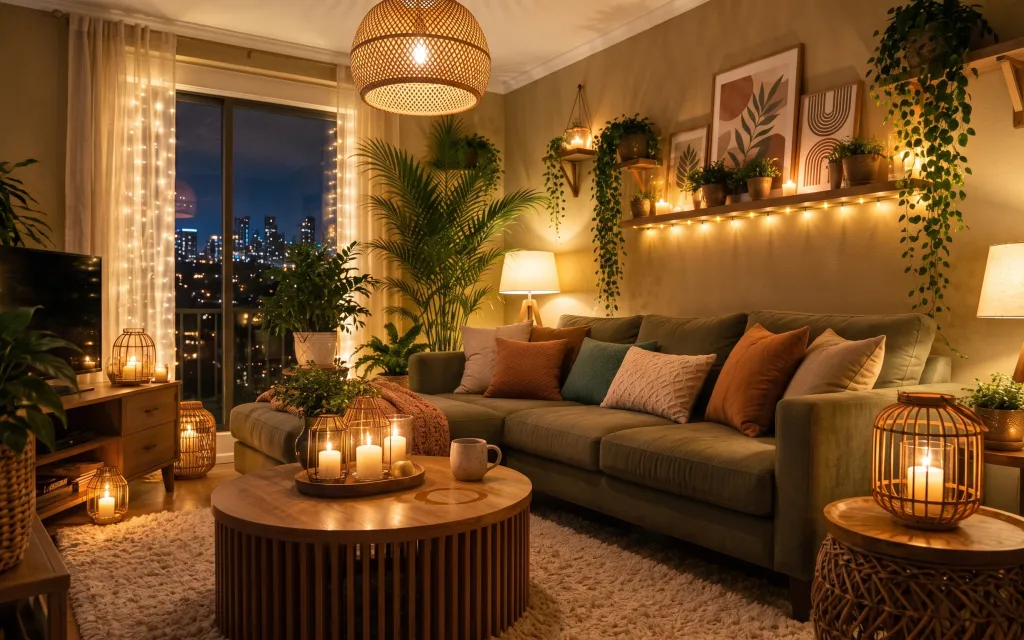
Why this warm woven-lamp setup is the sofa corner of 2026
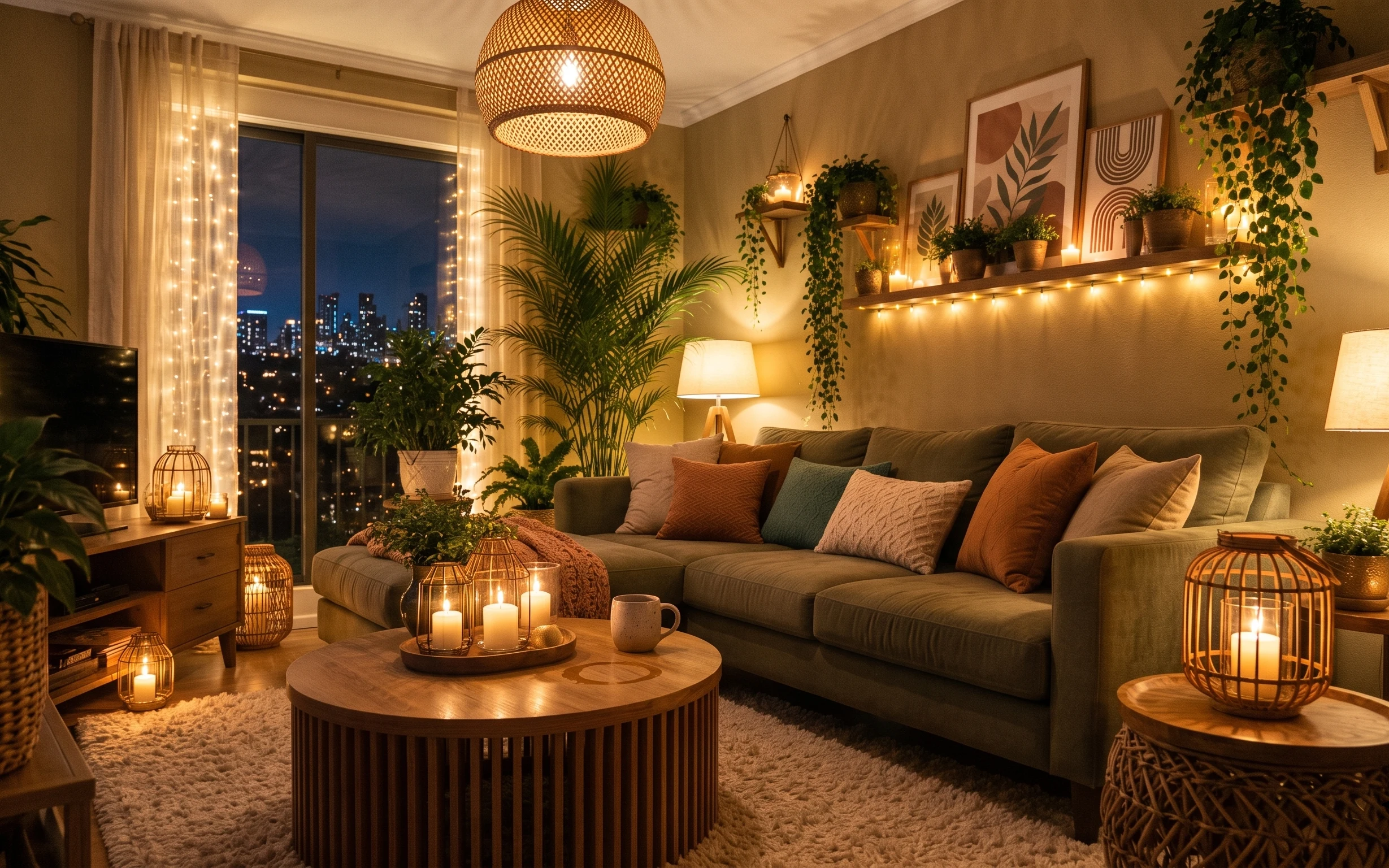
The thing I always notice first in this photo is the glow: the woven pendant light reads soft and architectural, and it makes the olive green plants feel intentional instead of random. Under that light, the area rug anchors the sofa, while the curtain panels soften the harsh lines of big windows. Even the wall shelf matters—its height gives the plants a “designed” stacking moment. None of it requires demolition, which is exactly why homeowners can pick the highest-impact option they can actually finish this weekend.
Early on, I made a mistake I still catch myself making: I’d buy pretty decor before I fixed the big three—rug scale, curtain height, and how the light hits the room. When I finally did those in the right order, everything else looked like it belonged. Here, the warm lamp glow + layered plant styling does most of the work, so the refresh feels complete instead of “still waiting on one more thing.”
Layer 1 — area rug ($120) jute-like texture that hides wear
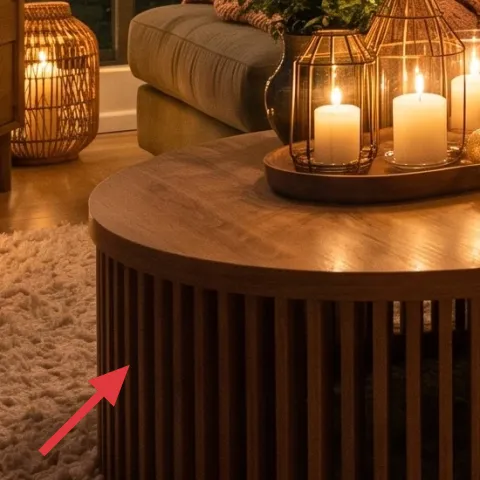
This area rug sits right in front of the sofa and pulls the whole corner into one zone. The texture matters because it softens the look of the wood floor and keeps the coffee table from feeling like it’s floating above bare ground. The trap with a sofa corner is choosing a rug that’s too small; you end up with a border of floor that makes everything look less intentional. This size and feel let the warm lantern candle holders and pillows read calmer instead of busy. The trade-off: thicker fibers mean more vacuuming, but it’s worth it for the cozy look.
Match rug edges to the sofa footprint
When the rug reaches under the front sofa legs, the room feels grounded instead of taped together.
Layer 2 — curtain panels ($60) floor-length softness without fuss
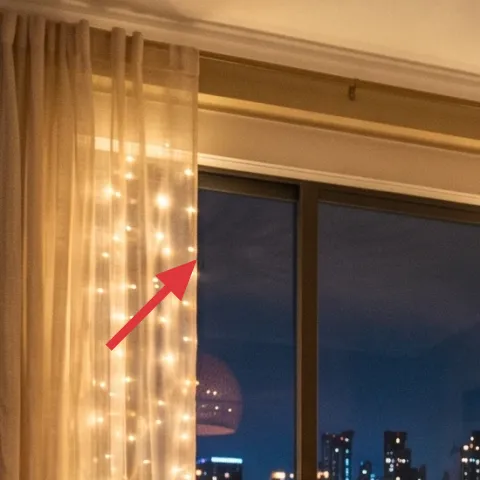
These curtain panels do two jobs: they frame the night view and they add a soft curtain line that balances the bold plant shapes. In a space like this, sheer fabric plus warm light turns into that glowing “cocoon” effect. If you go with short curtains, you’ll lose the vertical lift that makes the windows feel taller. This is an easy swap for homeowners because it’s about measuring and hanging correctly, not wall work. The trade-off is laundry time—curtains show dust when they’re that close to the light—but the payoff is huge.
Hang for height, not for exact window fit
Let the curtain panels kiss the floor (or hover just above) so the warm tone reads intentional.
Layer 3 — woven pendant light ($100) amber glow with texture
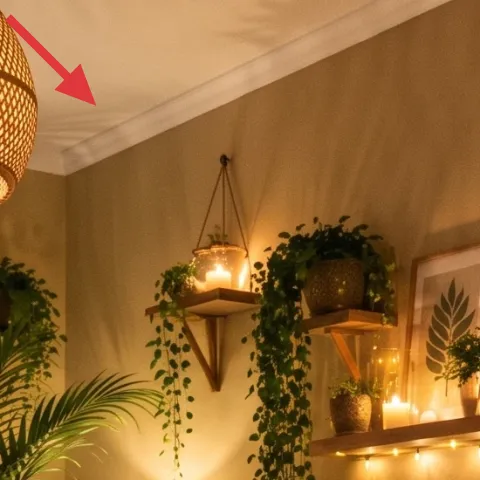
The woven pendant light brings texture to the ceiling and keeps the lighting from feeling flat. In this photo, it also ties into the wicker storage basket and the lantern-style candle holders, which is why the whole corner looks cohesive. The obvious alternative would be a plain drum shade—but woven light spreads warmth in a way that looks more curated, especially with leafy plants around it. If you’re choosing a replacement, prioritize a shade that creates shadowy patterning rather than a totally uniform glow. Trade-off: woven materials can look slightly darker than glass, so make sure your bulb brightness gives you enough light.
Don’t pair woven with a harsh cool bulb
A cool bulb can make the tan walls look gray and flatten the warm plant tones.
Layer 4 — wall shelf ($150) vertical plant stacking zone
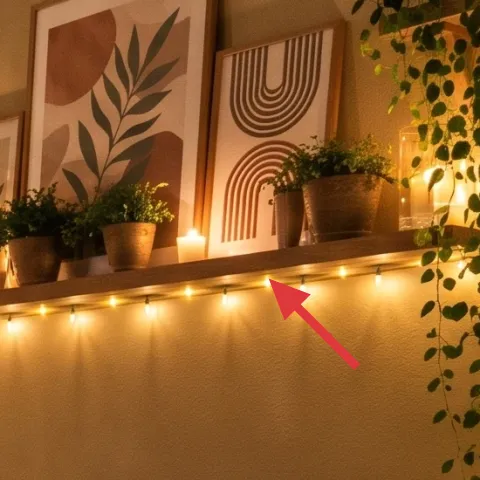
The wall shelf is doing real work here: it gives the plants a place to “live” at eye level while the trailing green plant spills down for movement. That height is key—when shelf styling sits too low, it competes with the coffee table; too high, and it becomes decoration that never gets noticed. The shelf also helps you place small objects (like candle jars and potted plants) without crowding the sofa. If you only copy one organizing move, copy this—vertical styling makes a corner feel designed even before you add anything else. Trade-off: it’s a dust magnet, so plan for quick weekly wipe-downs.
Build the shelf from big to small
Start with the tallest potted palm plant, then fill around it with tighter-leaf plants and one candle moment.
Layer 5 — framed botanical prints ($120) calm pattern that repeats the leaf shapes
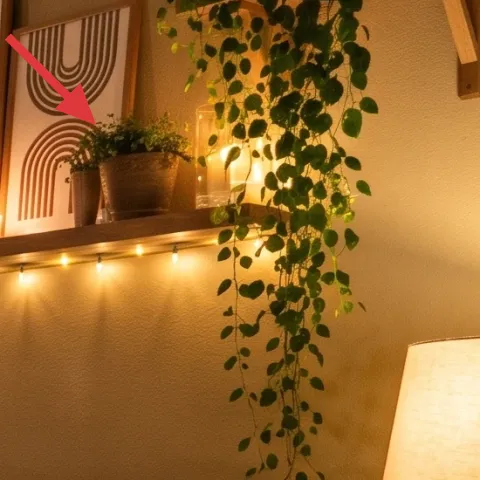
These framed botanical prints keep the wall from turning into only plants-with-leaves—there’s pattern variety, but it still belongs. The earthy tones in the prints echo the warm tan walls and the olive green foliage, which is why the shelf doesn’t feel like it’s fighting the wall. The alternative would be one oversized piece, but a smaller framed layout gives you a softer rhythm next to the wall shelf. The trade-off is spacing: if frames are too close, the wall looks cluttered; too far, and it stops reading as a set.
Keep a consistent frame width
That small uniform detail makes different botanical images look intentional together.
Layer 6 — throw pillows ($30) olive-and-cream contrast on the sofa
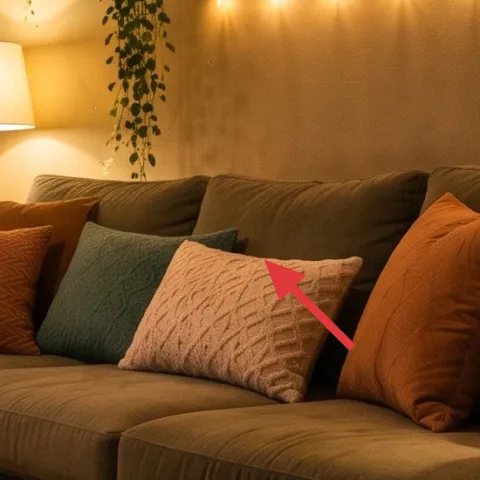
The throw pillows are the color bridge between the olive green plants and the cream tones around the room. They also add scale: soft cushions stop the corner from looking too crisp next to the woven pendant light and the wood surfaces. In this setup, the patterned pillow covers add texture without adding another “theme,” because the patterns stay botanical/leaf-like. If you only bought solid pillows, the room would look calmer, but you’d lose that detail that makes the scene feel styled. Trade-off: patterned fabrics can fade a bit faster in direct light, so keep curtains drawn during the brightest hours if your window gets intense sun.
Use one patterned pillow max
Two max if the patterns are in the same color family—more than that tends to fight the plants.
Layer 7 — round coffee table ($180) paint it to match the warm palette
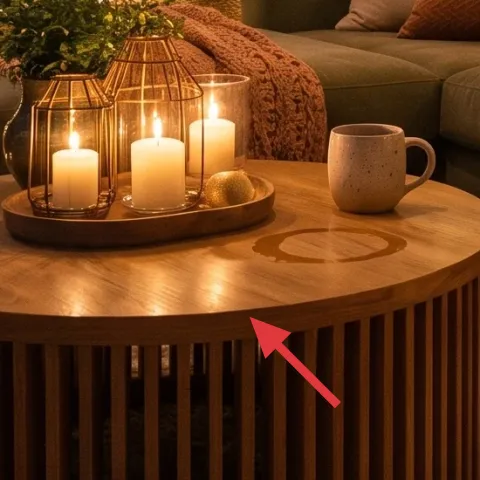
This round coffee table is where the corner “lands”—it’s visually close to the lantern-style candle holders, mugs, and small potted plants, so its finish has to look good under warm light. When the table surface is the right tone, the whole setup feels edited instead of accidental. You could replace it, but painting is faster and more budget-friendly, especially when you’re aiming for that warm, cohesive base. The trade-off is that painting takes prep time; rushed sanding shows up as uneven sheen in candlelight. Still, the payoff is huge because the coffee table ties together the rug texture, woven lighting, and tan walls.
Make it instead of buying it
DIY the look by sanding and painting the round coffee table so it matches the warm tan/cream palette under the woven pendant light.
Materials
- All-purpose cleaner & degreaser — 1 bottle — hardware/discount store — $4
- Sandpaper (medium + fine) — assorted sheets — hardware store — $18
- Bonding/adhesion primer — 1 quart — paint store — $22
- Interior paint (warm cream/tan) — 1 quart — paint store — $22
- Small foam roller + angled brush — 1 set — hardware store — $9
- Tack cloth — 1 pack — hardware store — $4
- Clear matte topcoat (optional for durability) — 1 small can — paint store — $15
Steps
- Clean the entire coffee table with degreaser and let it dry fully.
- Lightly sand the surface to scuff the sheen (focus on edges and corners).
- Wipe off dust with a tack cloth so primer can grip.
- Apply bonding primer in thin, even coats and let it dry.
- Sand lightly with fine sandpaper to smooth any bumps, then wipe again.
- Roll on the first paint coat, keeping edges crisp near the tabletop lip.
- Let the paint dry completely per the label, then apply the second coat.
- If using a topcoat, apply a thin matte coat and let it cure before heavy use.
- Re-set lantern-style candle holders carefully once fully cured.
Total DIY cost: $80 — saves about $100 over buying.
The cost, layer by layer
| Layer | Item | Cost |
|---|---|---|
| 1 | Area rug | $120 |
| 2 | Curtain panels | $60 |
| 3 | Woven pendant light | $100 |
| 4 | Wall shelf | $150 |
| 5 | Framed botanical prints | $120 |
| 6 | Throw pillows | $30 |
| 7 | Painted round coffee table finish (DIY) | $180 |
| Total | $760 | |
If you want a cheaper variant, start with the rug, curtain panels, and throw pillows first—then delay the woven pendant light and wall shelf until the next weekend.
What worked, what didn't (across the whole room)
The best part of this sofa corner recipe is that it layers warmth at different heights: overhead with the woven pendant light, mid-level with the wall shelf, and grounded with the area rug. The plant stacking also gives the wall depth without needing major layout changes. The main misses are usually scale and placement—when curtains hang too short or the rug doesn’t extend under the sofa, the whole corner looks less intentional.
What worked
- The area rug anchors the sofa and makes lantern lighting feel less “scattered” at night.
- Curtain panels add softness and height, which keeps the corner from feeling visually cramped.
- The woven pendant light casts a warm, textured glow that flatters olive green plants.
- The wall shelf creates a vertical plant-and-candle styling moment without crowding the sofa.
- Framed botanical prints repeat leaf-like shapes so the plants don’t become the only pattern.
- Throw pillows add contrast in cream and olive, preventing the sofa from blending into the walls.
What didn't
- Too-small rug sizes leave visible floor around the sofa and weaken the “designed” feeling.
- Curtains hung low can make large windows feel shorter and pull the eye toward clutter.
- Cool-light bulbs under the woven pendant light make the warm tan walls look gray.
- Wall shelf styling that’s all the same height looks flat next to trailing green plants.
- Overdoing patterned throw pillows competes with the plant texture and framed botanical prints.
What we'd skip if we did it again
Skip replacing the whole coffee table if it’s structurally fine. Painting the round coffee table finish gives the same visual payoff—especially under warm candlelight—without spending your weekend on a delivery and old-piece disposal.
Skip hanging artwork without thinking in groupings. With framed botanical prints, the set effect matters; choosing mismatched widths and spacing makes the wall shelf feel accidental instead of curated.
Skip buying extra decor pieces to fill gaps before the basics are set. Rug scale, curtain panel height, and how the woven pendant light lands on plants are the order that makes everything else look “right.”
Frequently asked
How long does this sofa corner refresh usually take?
Plan for a long weekend for the non-DIY swaps (rug, curtain panels, wall shelf styling, and framed botanical prints). The slow part is painting the round coffee table: sanding, primer, paint coats, and full drying/cure. If you’re busy, do everything else first, then paint the table last so you’re not working around drying times.
If I rent, what parts of this should I still do?
Skip the paint step and focus on the renter-friendly visuals: area rug positioning, curtain panels, and swapping out the woven pendant light only if your landlord allows it (or choose a plug-in pendant alternative). For wall decor, use removable hangers for framed botanical prints and keep the wall shelf as a temporary option only if your rental rules allow anchors.
My room is smaller—should I scale down anything?
Yes, mainly the area rug and how far it extends under the sofa. In a smaller sofa corner, choose a rug that still reaches under the front legs so the space feels unified. Keep throw pillows to a tighter palette—olive and cream still work—so the corner doesn’t feel overcrowded with plant volume and patterns.
What if my ceilings are higher or lower than in the photo?
Higher ceilings usually benefit from curtain panels hung a bit higher and a woven pendant light with a slightly longer drop so it doesn’t feel lost. Lower ceilings need tighter spacing—hang curtains high enough for height, but keep the pendant drop conservative so the light doesn’t feel like it’s hovering too low.
Where should I shop differently to get this look on a budget?
For the big visual drivers, buy in-store or from reputable retailers for the best scale: area rug size and curtain panel length. For framed botanical prints and the wall shelf, mix sources—thrift or discount can work well if you keep frame widths consistent and choose plants that match your light conditions.
What’s the biggest mistake in a sofa corner like this?
Choosing one element that’s the wrong scale—most often a rug that’s too small or curtains that are hung too short. In warm, plant-filled rooms, that mismatch makes the whole corner look “in progress.” Get rug size and curtain height right first, then build wall shelf styling and framed botanical prints around it.
More in Living Room
What $800 buys: a plant-filled living room refresh with 7 weekend swaps
Turn a plain sofa corner into a warm, plant-filled hangout with curtains, layered lighting, and framed botanicals. This $800 refresh focuse…
Under $250: no-drill swaps for a warm gray sofa seating area
A warm, japandi-style sofa seating area refresh you can recreate for about $250 using renter-safe swaps. Focus on soft gray textiles, a sty…
5 no-drill living room updates for $600
A warm, plant-heavy living room refresh with $550 in move-ready swaps and one no-drill DIY. Focus: a dyed green pillow, layered textiles, a…